The Mystery Called Hardware Manufacturing
#31 The Mystery Called Hardware Manufacturing
This series is about what we’re learning, observing and experiencing while building our startup Saent (pronounce “Saint”). The good, the bad and especially the ugly, each time in under 5 minutes reading time.
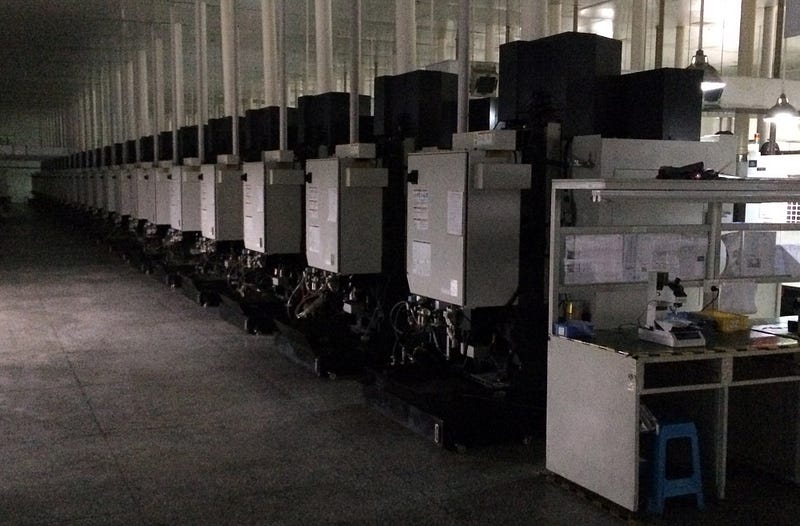
Machines like these were used in the tooling process for the Saent button to make custom components.
One of our dedicated crowdfunding supporters posted the following comment on our Indiegogo page:
“As production is underway as of 15th April, and according to the backers numbers, there are less than a few hundred units to make and deliver — can you now, without further delay, give us a fixed date for shipping?”
This reminded me of how I originally envisioned the hardware manufacturing process would work; once you start production, finished buttons start rolling off the conveyor belt. Co-founder Russell had told me manufacturing would likely take six weeks. We’re producing 1,500 of them, so I did the math, about 250 units should be coming off the assembly lines each week.
Intuitively this seems to make sense, but if you think more deeply about it, it’s actually rather odd. Why should the production of a relatively simple device (compared to say, a smartphone or laptop) at a relatively tiny volume (for normal manufacturing standards) move at such a low speed? Surely companies like Apple produce that many iPhones per hour (it’s actually way more!), in factories in China similar to the ones where we are making our device. Something doesn’t add up here…
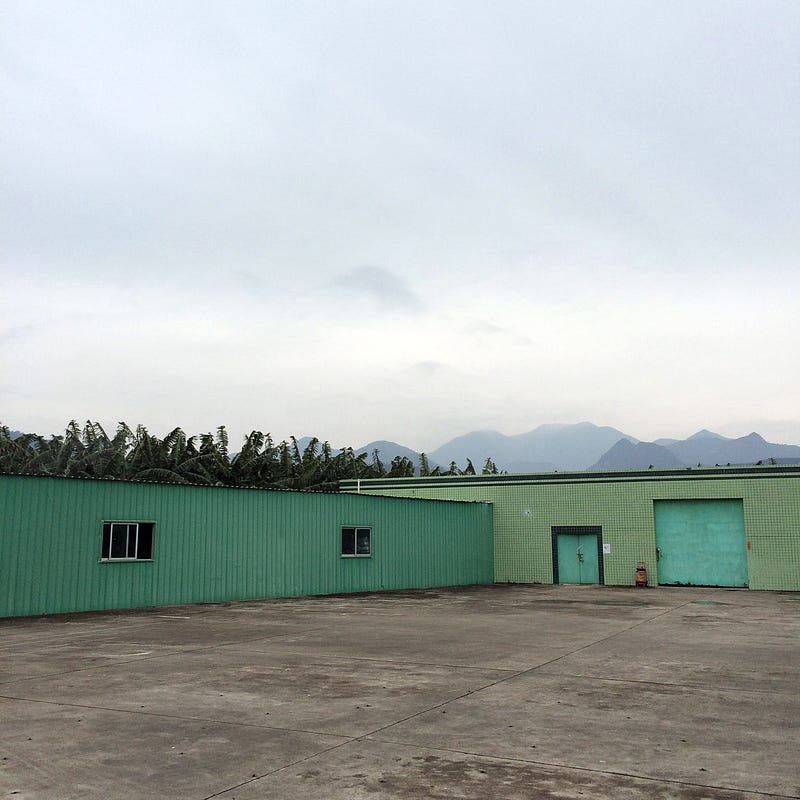
Outside view of the factory of one of our production partners in Shenzhen, China.
The pieces of the puzzle
If completed Saent buttons had been rolling out of the factory at a rate of 250 units per week since April, we would have certainly started shipping some of them by now. But that’s not what’s happening. We only end up with completed devices after assembly — a process that for all 1,500 buttons takes only a matter of days. That’s the final step before shipping, but we can’t do it until a lot of other stuff happens first.
Before assembly can take place, a lot of activities are moving simultaneously: plastics get molded, the rubber feet get made, the outside gets painted, circuit boards are printed, the final firmware needs to be “flashed” onto the device, the device needs to be certified for a wide range of countries, and so on. There are at least a dozen of these processes ongoing in tandem from the moment we “start production,” and they are spread out between contractors, subcontractors and sometimes even sub-subcontractors. What’s more, this still involves a lot of testing and quality checking; the color of the paint on the rubber foot might be off, there could be a small bump in the plastic, some laser cuts have not been made right. The list is long and all these things do happen, because…
Humans inside
Besides the process not being as linear as I expected, the other surprise involved humans. I thought at least 90% of production would be done with automated machines. Reality turns out to be very different: some parts are indeed produced by mean-looking machines, but as much as 80% of the process is done by human hands.
The devices are assembled by hand, they’re painted by hand, they’re packaged by hand. The process is much less automated than you might expect. For this reason, a lot of the production timeline actually involves “practicing” assembly with the different parts that have been made. You make sure things are done correctly, if necessary try again (and again, and again), until finally everything fits and works.
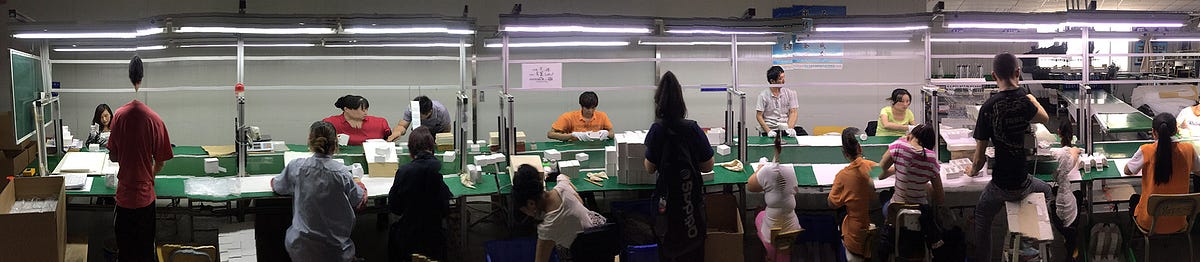
Assembling each individual Saent package is done by hand.
Then, and only then, does the actual assembly of the 1,500 final products happen, which at this point is relatively easy (though there always remains a chance something goes wrong).
None of this is meant as an excuse of the delays we’ve faced so far, but hopefully it shines some light on a process that applies to most of the products you see around you, but was also a complete mystery to me until very recently.
Ready to give Saent a try?
Download the free app now to start working smarter, being more focused, and developing better work habits.
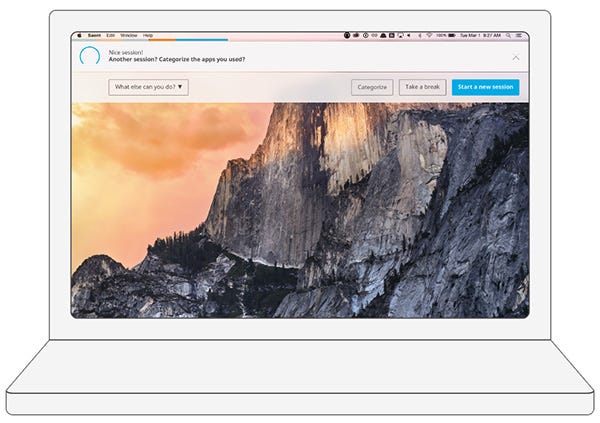
You can download the free version of the Saent app now by clicking the image above.
Or buy your Saent button (now shipping!) with a 12-month subscription to the Premium Saent app included!